

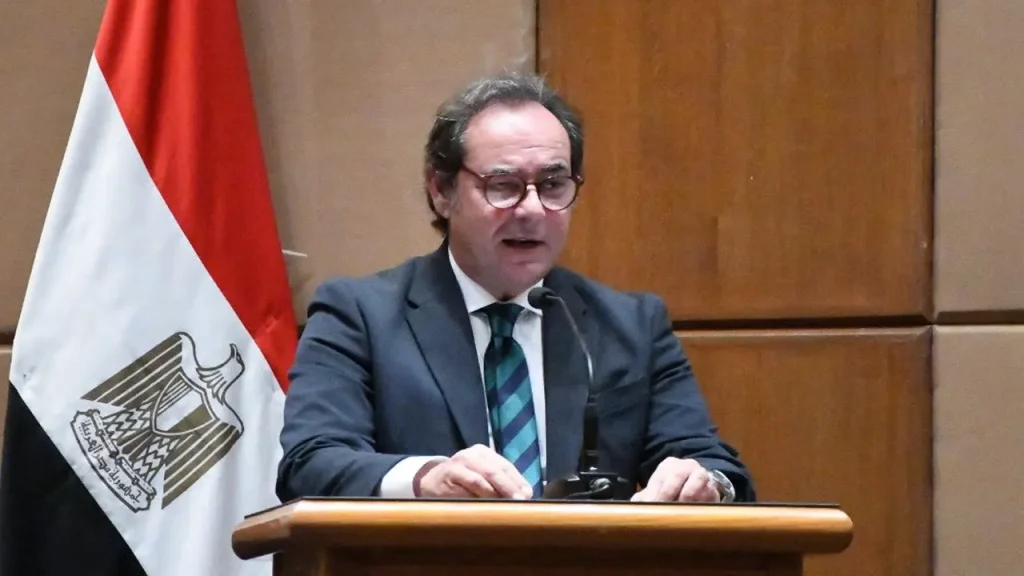
Ladies and Gentlemen,
Representatives of ministries and national and international institutions,
Distinguished guests,
It gives me great pleasure and honor to welcome you today to the opening of the third edition of the Gaia Forum. I also convey to you the greetings of H.E. Prof. Dr. Manal Awad, Minister of Local Development and Environment, along with her sincere wishes for the success of this forum. The event brings together an elite group of experts, innovators, entrepreneurs, and partners dedicated to building a more sustainable future—one based on the rational use of resources, maximizing the economic value of natural assets, and transforming environmental challenges into opportunities for growth, investment, and job creation.
I would like to express my appreciation to the development partners participating in this forum as we begin a new phase of regional environmental action, with Egypt assuming the presidency of the Bureau of the Contracting Parties to the Barcelona Convention for the 2026–2027 term.
This regional responsibility builds upon the role Egypt played in hosting the 24th Meeting of the Contracting Parties to the Barcelona Convention in Cairo (December 2–5, 2025). That meeting saw the adoption of the “Cairo Ministerial Declaration” and a suite of decisions and frameworks crucial to the future of environmental action in the Mediterranean basin. Through its presidency of the conference and the Cairo Declaration, Egypt has affirmed that protecting the marine and coastal environment is inseparable from achieving economic and social development. Furthermore, the future of the Mediterranean Sea hinges on our ability to build a sustainable blue economy—one that is more resource-efficient and better equipped to face the challenge of climate change.
Ladies and Gentlemen,
The concept of the circular economy is no longer merely an environmental notion limited to waste recycling. Today, it represents an integrated economic model that rethinks how we design, manufacture, consume, and reuse products and resources.
Data on climate and environmental investments indicate genuine opportunities in Egypt’s green and circular economy sectors. Realizing these opportunities requires concerted regional and international efforts—specifically in capacity building, financing, and technology transfer—to translate them into tangible, on-the-ground activities and projects. This approach relies on applying circular economy principles, which offer a key solution for addressing and curbing environmental degradation.
In this context, Egypt has made significant steps, The State has adopted a new legislative and institutional framework for waste management—spearheaded by the Waste Management Regulation Law No. 202 of 2020. This law is grounded in the principles of the circular economy and Extended Producer Responsibility (EPR), clearly defines roles and responsibilities, and opens the door for private sector participation in the waste management system. The Ministry has also established an Environmental and Climate Investment Unit aimed at attracting climate-related investments, stimulating the green economy, opening new markets for environmental investments, and providing technical support to investors by highlighting investment opportunities and linking projects with sources of green finance.
Over the past few years, the Ministry’s philosophy has evolved from merely raising environmental awareness to a more advanced stage centered on integrating environmental considerations into economic, investment, and development policies. Today, we possess a robust framework comprising supportive legislation, specialized institutions, an environmental and climate investment platform, defined investment opportunities, green finance instruments—developed through partnerships with international institutions—as well as a vision for the circular economy, a blue economy agenda, and a growing regional role in the Mediterranean.
The digital transformation of environmental services complements this shift; the Environmental Affairs Agency’s electronic system enables the delivery of services such as environmental impact assessments and the unified environmental registry, thereby streamlining procedures, enhancing service efficiency, and promoting transparency.
Furthermore, we are working to embed the concept of a sustainable blue economy, which links the protection of marine ecosystems and biodiversity with sustainable tourism, sustainable fisheries, ports and maritime transport, marine energy, and the reduction of marine pollution and waste.
Internationally, this approach was clearly reflected in the outcomes of the 24th Conference of the Parties (COP24) to the Barcelona Convention, which adopted the sustainable blue economy as its central theme and as a pathway for sustainable development in the current phase.
At the regional level, through our participation in the Global Environment Facility-funded regional project—implemented in cooperation with the UN Environment Programme—we aim to achieve a sustainable blue economy in the Red Sea and Gulf of Aden. Our objectives include updating the Strategic Action Programme for the Red Sea region, preparing an integrated management plan for the Great Fringing Reef Reserve, and applying sustainability principles within the South Sinai protected areas.
At the national level, we are working to finalize the first integrated national blue economy strategy, with the participation of all relevant stakeholders.
Ladies and Gentlemen,
Egyptian women are integral partners in innovation, investment, and decision-making. They are closest to issues concerning water, food, and health within the community and are among the groups most affected by the impacts of climate change; therefore, their involvement in formulating solutions is essential for the success and equity of environmental policies. In the circular economy, women play a prominent role in spearheading small and micro-scale recycling projects, thereby linking the circular economy to local development and creating sustainable job opportunities.
Regarding the blue economy, data from the Food and Agriculture Organization (FAO) at 2024 indicates that women account for approximately 40% of the global workforce in the aquatic value chain and about 62% in post-harvest activities, compared to roughly 24% among fishers and aquaculture producers. Consequently, the parties to the Cairo Declaration have committed to expanding the representation of women’s and youth organizations in regional efforts across the Mediterranean basin.
In this context, I would like to highlight the role of the National Council for Women—a key partner of the Ministry since the cooperation protocol signed in March 2002, which has translated into community awareness campaigns across various governorates. The Council includes a committee dedicated to the environment and climate change; furthermore, the “National Strategy for the Empowerment of Egyptian Women 2030” prioritizes women’s role in environmental protection, while the “National Strategy for Climate Change 2050” incorporates a perspective on their empowerment.
Distinguished guests,
The message we convey today is clear: development and the environment are not conflicting paths. On the contrary, the environment can serve as a driver for development; waste can be transformed into resources; innovation can turn into investment; the climate challenge can become an opportunity for modernization; and women can transition from mere beneficiaries of development programs to leaders of the future economy.
In this spirit, I look forward to the Gaia Forum serving as a springboard for further cooperation and partnerships—turning the circular economy into a tangible reality that helps build new, concrete bridges across the Mediterranean region.
We hereby reaffirm our commitment to working towards:
- A more efficient circular economy.
- A more sustainable blue economy.
- More resilient local communities.
- Greater participation of women and youth. 5. A Healthier and More Sustainable Mediterranean
In conclusion, I extend my sincere thanks and appreciation to all our partners and the organizers of this forum dedicated to a more sustainable future. To all participants, I say: the future belongs not merely to those who possess resources, but to those who can utilize them in a more sustainable and prudent manner.
It gives me great pleasure to declare the Gaia Forum open. I wish all participants fruitful proceedings and successful partnerships, and I hope that the outcomes of this forum translate into productive results.