

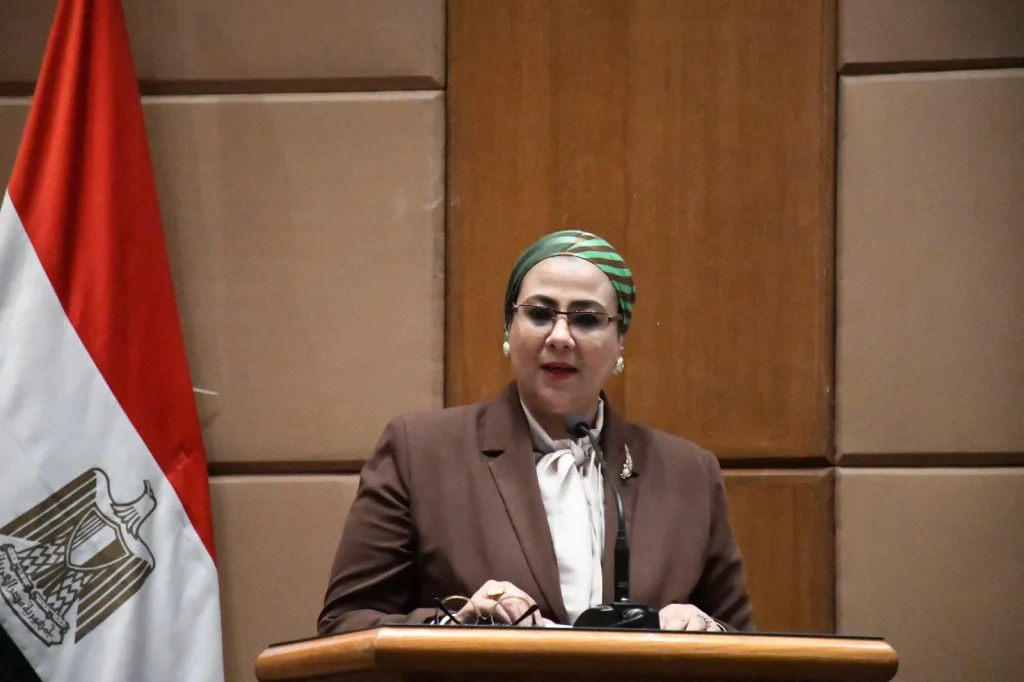
Address by Her Excellency Counselor Amal Ammar, President of the National Council for Women, at the “GAIA Circular Economy Forum 2026” (Sunday, 11 October 2026, Cairo)
In the name of God, the Most Gracious, the Most Merciful.
Eng. Sherif Abdel Rahim, Chief Executive Officer of the Egyptian Environmental Affairs Agency,
Ladies and gentlemen, representatives of national bodies and international organizations,
Distinguished guests,
I am pleased to join you today at the GAIA 2026 Forum, which addresses an issue of great importance for the future of development: how to achieve economic growth while preserving our natural resources and making the most of them for the benefit of present and future generations.
I extend my sincere thanks and appreciation to Her Excellency Dr. Manal Awad, Minister of Local Development and Environment, for her efforts in supporting this forum. I also thank the European Law Organization, the United Nations Environment Programme, and all the organizing bodies.
Ladies and gentlemen,
The transition to the green, circular, and blue economies is no longer merely an environmental orientation. It has become a promising economic path that opens new avenues for investment, production, and employment, and gives us an opportunity to rethink how we invest our resources and turn environmental challenges into economic value.
In this transition, women stand out as a productive force with the capacity to innovate, manage projects, and contribute to building a more efficient and sustainable economy.
The Egyptian state has recognized the importance of investing in women’s capabilities, with the continued support of His Excellency President Abdel Fattah El-Sisi, who has made women’s empowerment and the strengthening of their participation in all areas of national life one of the fundamental pillars of the development journey.
The launch of the National Strategy for the Empowerment of Egyptian Women 2030 in 2017 established an integrated national framework that strengthens women’s participation in development and expands the opportunities available to them across sectors.
Distinguished guests,
Proceeding from this vision, the National Council for Women, as an independent national council and the national mechanism for the empowerment of Egyptian women, plays an active role in linking economic empowerment to the pathways of sustainable development, 3
through programs and projects that invest in women’s capabilities and open new productive opportunities for them.
In the field of the circular economy, the Council has adopted a project to produce organic fertilizer (“compost”) for rural women. It relies on using organic waste and turning it into a product of economic value, creating a productive activity linked to the needs of the agricultural sector and helping to maximize the use of local resources.
In the field of the blue economy, the Council has trained women in Kafr El-Sheikh Governorate in fish and fish processing industries and developed their productive skills, which strengthens their participation in economic activities related to fisheries and widens opportunities to improve income in local communities.
In support of innovation, the Council actively participates in the National Initiative for Smart Green Projects, launched by the Egyptian state under the patronage of the President of the Republic. Among its six categories, the initiative includes a dedicated category for development projects related to women, climate change, and sustainability.
Through its branches across the governorates, the Council has encouraged women and girls to take part in the initiative, raised awareness of the opportunities to submit their projects, and highlighted outstanding women’s success stories.
The third edition of the initiative saw 1,151 projects submitted in the women’s category, reflecting the scale of the ideas and innovative capacities that Egyptian women possess.
Among the outstanding examples to emerge from the initiative is a project that recycles shrimp-shell waste and improves the living standards of women in the village of Shakshouk in Fayoum Governorate. It combines the circular economy with the use of resources linked to fishing activities, and offers a practical example of how environmental sustainability can go hand in hand with economic and social returns.
Ladies and gentlemen,
These projects reflect a clear institutional direction for the Council: moving from awareness-raising and training to supporting participation in sustainable productive activities.
Accordingly, the next phase requires strengthening the link between sustainable projects and market needs, facilitating access to finance and technology, and developing 4
partnerships with the private sector and relevant institutions, so that promising projects can grow, compete, and generate lasting economic returns.
We believe that investment in these fields benefits not only women, but extends to the family, the local community, and the national economy, and strengthens communities’ ability to use their resources more efficiently.
Distinguished guests,
The participation of the National Council for Women in the Conferences of the Parties (COP) to the United Nations Framework Convention on Climate Change has been a pivotal milestone in consolidating the Egyptian and regional vision that links gender equality with climate justice. Over successive sessions, the Council’s role has evolved from highlighting the direct impacts of climate change on women and girls, who are among those most affected by its environmental and social consequences, to spotlighting them as key partners and leaders in developing solutions and shaping policies.
Through pioneering initiatives such as the “African Women and Climate Change Adaptation” initiative, the organization of high-level events, and support for green economy and environmental innovation projects for rural women and women entrepreneurs, the Council has succeeded in integrating a gender perspective into climate finance and adaptation frameworks. This has made the Council’s experience a model to be emulated in placing women at the heart of the global and sustainable climate action agenda.
Ladies and gentlemen,
Egyptian women have proven their presence and their ability to work, produce, and innovate. The successful examples we see confirm that providing them with the right opportunities opens broad horizons for development.
We look forward to the discussions of this forum strengthening cooperation and the exchange of expertise, and producing practical initiatives that support women’s participation in new economic sectors.
In conclusion,
I affirm that the success of a sustainable economy is measured not only by the resources we preserve, but also by the opportunities we create and the economic and social value we achieve.
At the National Council for Women, we are working to turn the capabilities and ideas of Egyptian women into a genuine productive force, contributing to a stronger, more competitive, and more sustainable national economy. 5
Thank you all, and I wish the forum’s proceedings every success.
Peace, mercy, and blessings of God be upon you.