

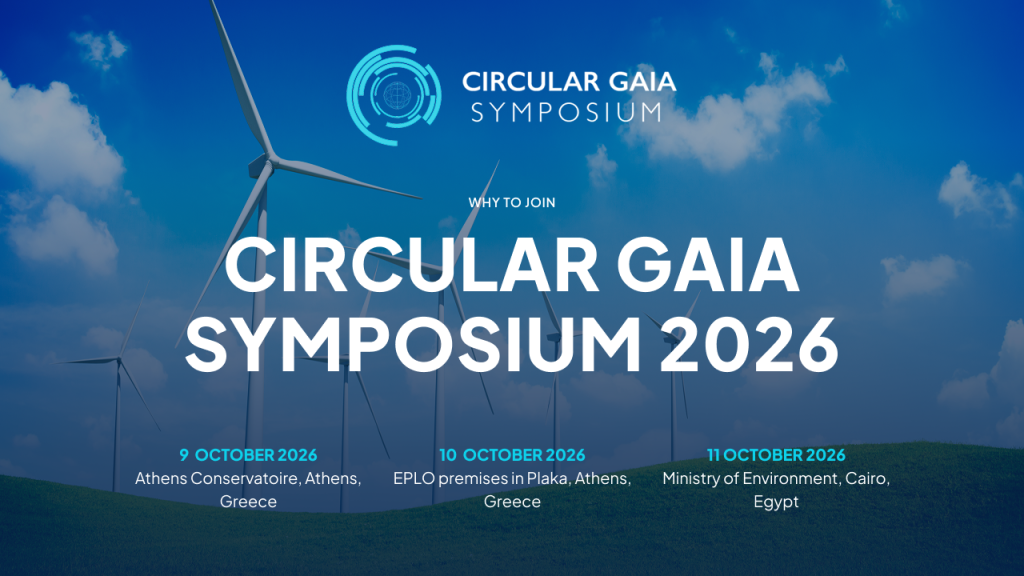
Three days, two capitals, one opportunity to shape the future of the Mediterranean Conferences on sustainability are everywhere. So why should you set aside time for Circular Gaia 2026? Because this symposium is designed not just to talk about the green transition, but to connect the people, institutions and ideas that make it happen. On 9–10 October in Athens and 11 October in Cairo, the Circular Economy, Environment, Energy and Climate Institute of the European Public Law Organization (EPLO) brings together governments, European and international institutions, academia, business, civil society and the financial sector for three days of high-level dialogue.
Here is what you will take home.
1. Direct access to the people shaping policy
Circular Gaia 2026 puts you in the same room as the decision-makers who design and implement the rules of the green transition. Opening the symposium in Athens are the Ecumenical Patriarch of Constantinople, the Prime Minister of Bulgaria, European Commissioners Apostolos Tzitzikostas and Costas Kadis, UNEP/MAP Coordinator Tatjana Hema and senior officials of the European Commission. Across the panels you will hear from Greek and Bulgarian ministers, the Executive Director of the European Environment Agency, the European Investment Bank, the EBRD, UNESCO and many more. In Cairo, the day opens with H.E. Manal Awad, Egypt’s Minister of Local Development and Environment.
Few events offer this concentration of European, Mediterranean and international leadership in one place.
2. A complete picture of the green transition
Over 14 thematic panels in Athens and two dedicated sessions in Cairo, you will explore the full spectrum of today’s most pressing questions: the new EU Circular Economy Act and international frameworks, energy transition and carbon neutrality, sustainable fuels for aviation and shipping, green finance and ESG, climate-resilient infrastructure, waste and wastewater as resources, circular islands and tourism, critical raw materials, farm-to-fork agroeconomy and circular cities.
Circular diplomacy, and the climate, energy and environmental diplomacy connected to it, sits at the heart of the programme, showing how international cooperation turns commitments into results.
3. New perspectives on AI and the “Brain Economy”
Circular Gaia looks ahead. A dedicated discussion on Green AI, Information Integrity and Climate will explore how Artificial Intelligence is reshaping sustainability, environmental information and climate governance. The symposium will also present the Brain Economy concept, examining how human knowledge, skills and wellbeing are becoming central assets of a resilient, future-ready economy.
4. A bridge to Egypt and the wider Mediterranean
This year, for the first time, Circular Gaia crosses the sea. The third day takes place at the Cairo House Cultural Center, co-organised with Egypt’ Ministry of Local Development and Environment and supported by UNEP/MAP, with panels on the Blue Economy and Women
in Sustainability.
Egypt is one of Africa’s leading forces in sustainability and currently holds the Presidency of the Barcelona Convention for the protection of the Mediterranean, whose Secretariat is based in Athens. For participants, this means a unique entry point into Euro-Mediterranean cooperation on the blue economy, energy, climate resilience, infrastructure and investment, and direct contact with Egyptian institutions and partners.
5. Real networking, not just business cards
Circular Gaia is built as a meeting point where public policy, science, investment and business solutions converge. Beyond the panels, receptions and breaks, participants can request dedicated government-to-government (g2g), business-to-business (b2b) and government-to-business (g2b) meetings within the framework of the symposium. Whether you are seeking partners, investors, clients or institutional contacts, the symposium can help you open the right doors.
6. From policy to practice
The symposium’s goal is to close the gap between policy commitments and real-world implementation. You will hear how regulators, municipalities, regions, universities, investors and companies are actually delivering circular solutions, and leave with practical ideas, contacts and opportunities you can apply in your own work.
7. Free participation, wherever you are
Registration is free of charge, and the symposium will be live-streamed, so no one is left out. Join us in person in Athens or Cairo for the full experience, or follow online from anywhere in the world.
Be part of the conversation
At a time when geopolitics, climate change, resource pressures, technological transformation and One Health challenges are more interconnected than ever, Circular Gaia 2026 offers something rare: a space for constructive dialogue that leads to partnerships and action.
- 9–10 October 2026 | Athens Conservatoire & EPLO, Plaka, Athens
- 11 October 2026 | Cairo House Cultural Center, Cairo
- Live-streamed | Free registration
- Register: https://circulargaia.org/register/